
Oct 16, 2026
Paper Gift Bag Rope Handle Load Test and Sample Acceptance Guide
A buyer-focused guide to specifying rope handles, reinforcement patches, sample load checks and inspection criteria for custom paper gift bags.
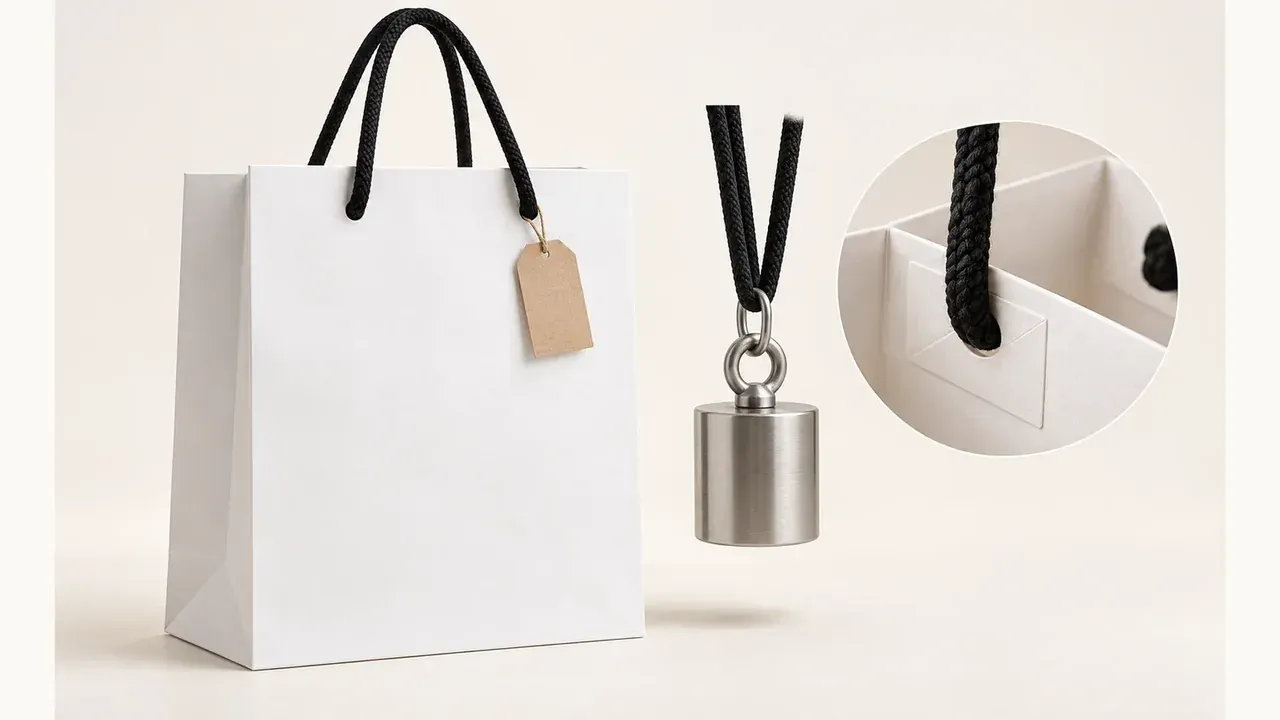
Paper gift bags often look simple on a quotation sheet, yet handle failure is one of the quickest ways for a retail order to become a returns problem. A useful RFQ does not merely request “strong handles.” It states the carried product, the bag size, the handle type, and the sample check the buyer wants to see before approving production.
This guide helps purchasing teams turn that risk into clear, reviewable specifications. Actual safe-load limits should be confirmed on the approved bag construction and product pack-out—not copied from a generic online chart.
Start with the real carried product, not a generic weight claim
Describe the intended contents: boxed cosmetics, a bottle set, apparel, catalogues, or a promotional bundle. Include the packed product weight, whether the load has sharp corners, and whether customers will carry the bag over distance. A compact, dense item can stress the handle patch more severely than a larger soft item of the same nominal weight.
Ask the supplier to confirm whether the quoted paper grade, bag width, gusset, rope diameter and handle-patch layout are suitable for that use. If the final retail contents are still changing, flag this as an open item instead of treating the bag sample as final validation.
Choose a handle construction that matches the buying scenario
Twisted-paper handles, cotton rope, PP rope and ribbon handles have different feel, cost and attachment options. Rope can support a premium presentation, but the visible rope is only one part of the assembly. The hole position, reinforcement sheet, adhesive system and fold geometry affect how the load transfers into the bag body.
For a branded retail bag, specify the handle material and color reference, rope diameter or width where applicable, knot or end treatment, handle drop, hole placement and whether internal reinforcement patches must remain hidden. A photo alone is not enough when multiple sizes will share one brand program.
Put the reinforcement patch on the sample-approval checklist
Request inside and outside photographs of both handle areas on the physical sample. The check should cover patch alignment, full adhesive contact, clean die-cut holes, no paper tearing around the hole, and no visible glue staining on the exterior. If lamination or a heavy surface finish is used, ask how the patch material and adhesive are selected for that surface.
Where a bag will carry a boxed product, it is sensible to inspect the top fold as well. A sound patch cannot compensate for a poorly formed top edge or an unsuitable bag body for the gusset and contents.
Agree on a repeatable sample load check
Use the actual or representative packed product whenever possible. The buyer and supplier should agree in writing on the sample method: how the load is placed, whether the bag is lifted and held or carried through a defined movement, how many sample bags are checked, and what visible damage counts as a failure.
Avoid publishing or promising a universal kilogram rating unless the factory has approved that exact figure for the specified construction. The useful outcome is a signed sample record showing the construction tested, the load used and the observed result. That record is more actionable than a vague “heavy-duty” label.
Plan production inspection before the PO is released
For larger orders, include handle checks in the pre-production and final-inspection plan. Confirm which approved sample is the visual standard, how color and rope batches are controlled, and whether the inspector will open selected bags to see internal patches. If third-party inspection is required, share the acceptance points before the booking so the inspection scope matches the PO.
Also state the packaging method. Compressed cartons, excess stacking pressure or moisture exposure during transit can deform rope handles or mark light-colored bag surfaces even when the handle construction itself is correct.
When to reconsider the bag specification
Custom rope handles are not the automatic answer for every order. A very low-volume launch, an unusually heavy product, a short deadline without time for a functional sample, or a product with sharp unsupported corners may call for a different handle, an insert, or a revised bag size. Raising that boundary early protects both the buyer’s timeline and the finished customer experience.
Quotation checklist
• [ ] Finished bag width, gusset and height, plus the packed product dimensions
• [ ] Intended contents and representative packed weight for sample testing
• [ ] Paper material, surface finish and top-fold construction
• [ ] Handle material, color reference, diameter/width, drop and attachment style
• [ ] Internal reinforcement-patch material, size and visibility requirement
• [ ] Sample load-check method, sample quantity and pass/fail observations
• [ ] Artwork file, print positions and color-proof requirement
• [ ] MOQ and production lead time confirmed for the selected material and finish
• [ ] Carton packing, moisture protection and destination requirements
• [ ] Inspection scope and any third-party inspection requirement