
Oct 29, 2026
Paper Gift Bags with Ribbon Handles: Length, Attachment and Retail Fit
Specify ribbon handles for custom paper gift bags with practical checks for carrying clearance, attachment, logo placement, packing, MOQ and delivery.
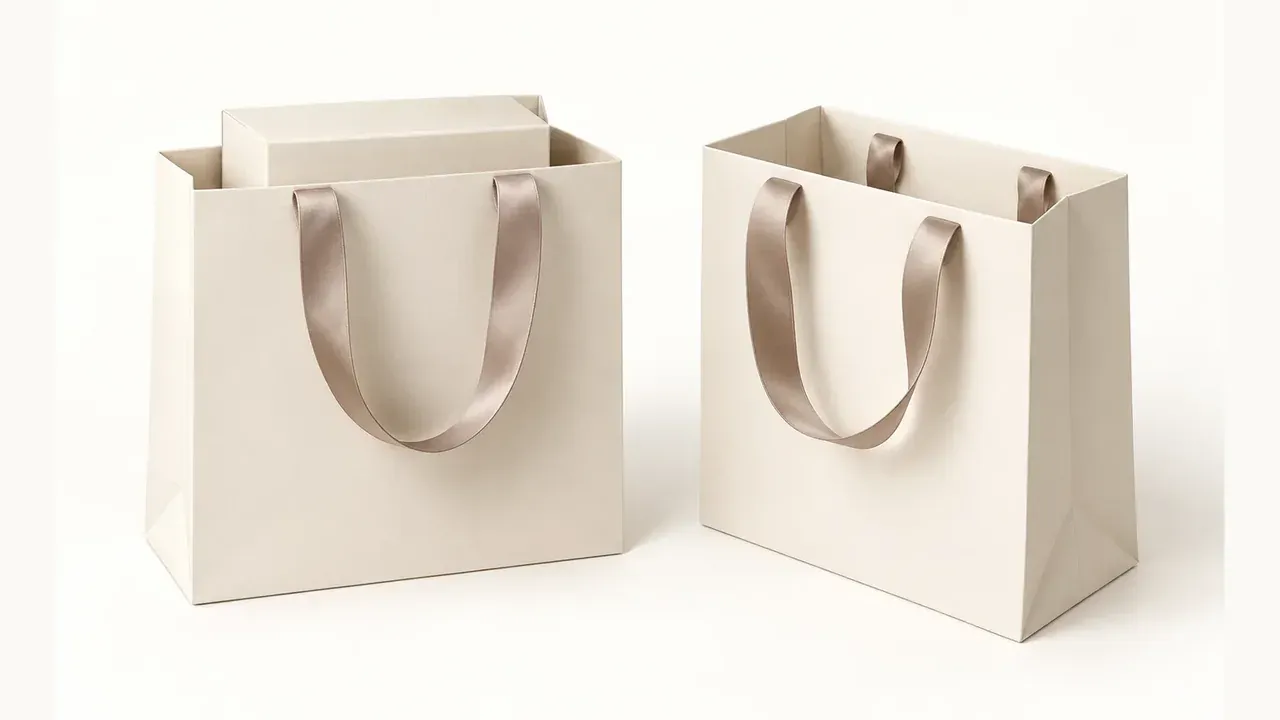
Ribbon handles can make a paper gift bag easier to present as part of a coordinated retail gift set. However, a handle that looks balanced in a photograph may feel awkward once a boxed product is inside. Buyers should approve the handle together with the filled bag, the printed artwork and the packing method before placing a bulk order.
This guide focuses on ribbon geometry and retail handling. It helps purchasing teams turn a visual preference into a specification that suppliers can quote and reproduce.
Start with the product and the carrying situation
Give the supplier the dimensions and packed weight of the actual product, including any gift paper box, tissue or protective insert. State whether customers will carry one bag, several bags together or a bag containing multiple items. These conditions affect how much clearance is needed above the top edge and how the handle sits in the hand.
Approve the bag with the intended contents. A tall box may push the two handle loops apart, while a wide box can change how the front panel bows. Check that staff can insert the product without catching it on the ribbon or its attachment points.
Define handle drop separately from ribbon cut length
Handle drop is the clearance between the top of the bag and the highest point of the loop in a stated measuring position. Ribbon cut length includes the material used inside the bag for knots, turns or other attachments. They are related but are not interchangeable specifications.
Use a sketch to show the measuring points, whether the bag is open or flattened, and whether the ribbon is pulled taut. Ask the factory to propose a manufacturing tolerance for approval. Record ribbon width and construction as well: a wider ribbon can change both the appearance and the way it folds through a hole.
Compare ribbon materials with physical samples
Satin, grosgrain and other woven ribbon constructions give different surface effects and handling characteristics. Request actual swatches rather than relying on finish names. Look at colour under consistent lighting, feel the edges, and check whether the ribbon twists or creases when the bag is flattened.
If recycled fibre content or a particular fibre composition is required, request documentation tied to the offered ribbon. A paper bag specification does not establish the composition of its handles. Keep material claims specific to the components for which evidence is available.
Approve attachment details and the inside appearance
Ask the supplier to show the ribbon attachment from inside the bag. Specify the hole position, reinforcement arrangement and the acceptable visibility of knots or tabs. Check whether an attachment interferes with the product, gift tissue or the opening of the bag.
Agree a functional carrying check using the intended load, a defined duration and a clear inspection method. Inspect for tearing, slippage and damage around the attachment after the check. The test conditions should be agreed for the intended application; a decorative ribbon appearance alone does not establish a carrying capacity.
Position logo printing around the handle area
Show the handle holes, top fold and ribbon on the artwork layout. A logo that looks centred on a flat panel can feel crowded when the ribbon falls across it. Review both a flat artwork proof and a completed sample with the handles in their natural position.
For foil, embossing or other surface finishes, confirm the available working area with the supplier before final artwork approval. Use a physical sample to check the relationship between the logo, top edge and ribbon colour. Screen colour should remain a communication aid rather than the sole production reference.
Check packing and store preparation
Request a packed sample showing how handles are arranged in each bundle. Loose ribbon can become trapped between bags or leave folds that staff must straighten. Ask whether the quoted packing method includes interleaving, individual protection or a particular handle position.
Run a short store-preparation trial: remove a bag from its bundle, open it, place the product inside and present it to a customer. Record any extra steps. A small change to packing or handle placement may improve daily use more than a purely decorative change.
Compare MOQ and delivery on the same specification
Ask whether minimum order quantity applies per bag size, ribbon colour, printed design or complete combination. A stock ribbon colour and a custom-dyed ribbon may have different purchasing requirements. Request separate explanations for sample costs, tooling, special materials and packing additions.
Confirm the point at which production lead time begins. Artwork approval, ribbon availability and signed sample approval may be separate milestones. Request the production completion date and shipping estimate separately so the delivery plan reflects the full route to your warehouse.
Quotation checklist
• Bag dimensions, dimension order, product dimensions and packed weight.
• Paper type, paper weight, top fold and reinforcement requirements.
• Ribbon material, construction, width, colour reference and swatch approval.
• Handle drop drawing, measuring position and agreed tolerance.
• Attachment method, hole positions and interior appearance.
• Logo artwork revision, print method and surface finish.
• Filled-bag sample and agreed carrying-check conditions.
• Bundle quantity, handle arrangement and carton protection.
• Order quantity by size, design and ribbon colour; MOQ for each combination.
• Sample charges, approval milestones, production timing and delivery destination.
Send the same specification to each shortlisted supplier and ask them to identify any proposed substitutions. This makes quotations easier to compare and gives the approved sample a clear role in the final purchase order.